Top 20 JavaScript Interview Questions and Answers (2026)
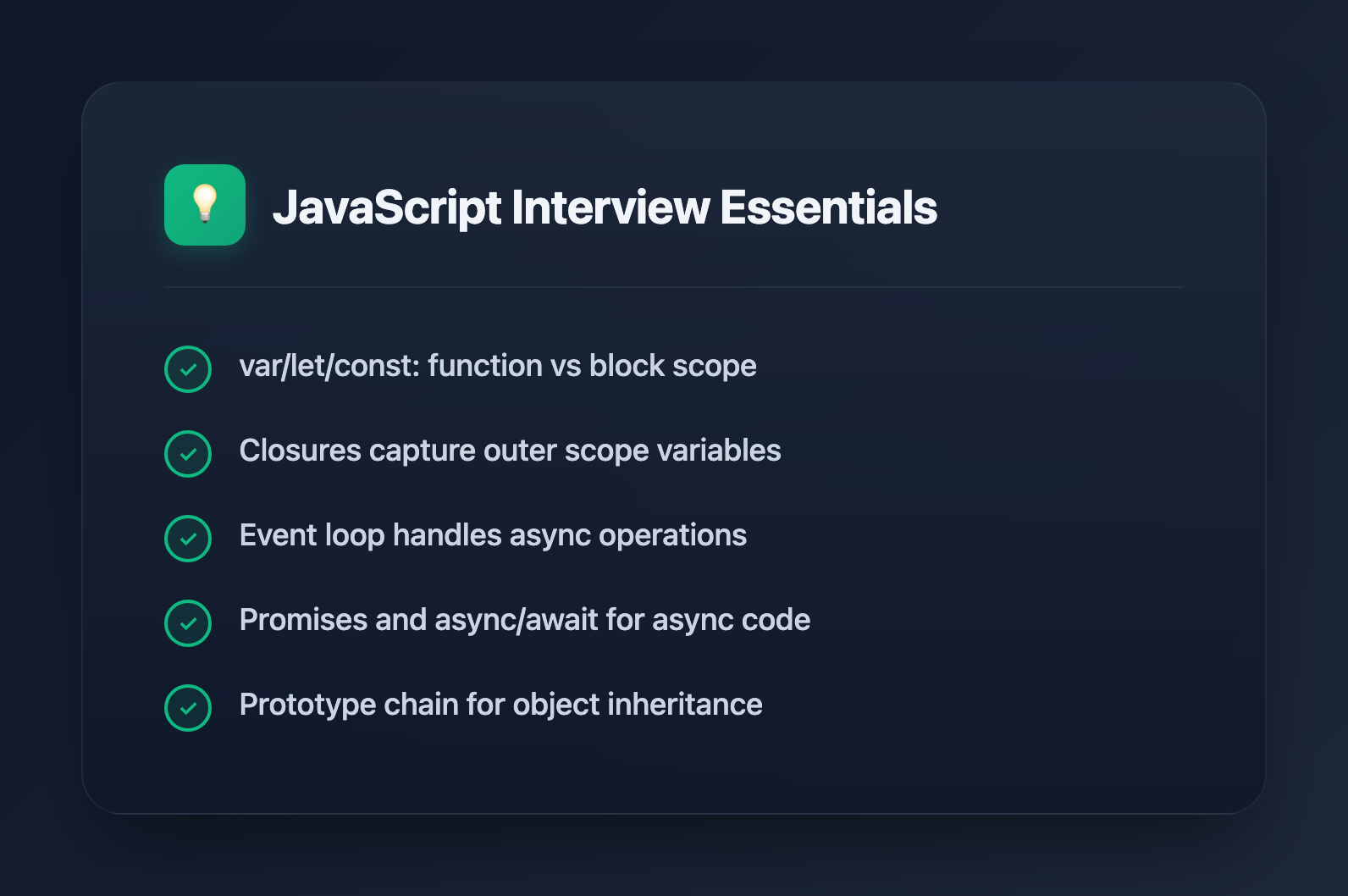
Prepare for your next JavaScript interview with these essential questions that cover fundamentals, ES6+, and common patterns.
1. What is the difference between var, let, and const?
Answer: var is function-scoped and hoisted, let and const are block-scoped. const cannot be reassigned after declaration, while let can.
var x = 1;  // function-scoped, hoisted
let y = 2;  // block-scoped
const z = 3; // block-scoped, immutable binding
2. Explain closures in JavaScript
Answer: A closure is a function that has access to variables from its outer (enclosing) scope, even after the outer function has returned.
function outer() {
  const message = "Hello";
  return function inner() {
    console.log(message); // closure captures "message"
  };
}
3. What is the event loop?
Answer: The event loop is JavaScript's concurrency model. It continuously checks the call stack and callback queue, executing callbacks when the stack is empty.
4. Difference between == and ===
Answer: == performs type coercion before comparison, === checks both value and type without coercion. Always prefer ===.
"5" == 5   // true (coerced)
"5" === 5  // false (different types)
5. What are Promises?
Answer: Promises represent the eventual completion (or failure) of an asynchronous operation. They have three states: pending, fulfilled, or rejected.
const promise = new Promise((resolve, reject) => {
  setTimeout(() => resolve("Done!"), 1000);
});
promise.then(result => console.log(result));
6. Explain async/await
Answer: async/await is syntactic sugar over Promises, making asynchronous code look synchronous and easier to read.
async function fetchData() {
  const response = await fetch(url);
  const data = await response.json();
  return data;
}
7. What is hoisting?
Answer: Hoisting is JavaScript's behavior of moving declarations to the top of their scope during compilation. Functions are fully hoisted, var declarations are hoisted but not initialized.
8. What is the prototype chain?
Answer: Every JavaScript object has a prototype. When accessing a property, JavaScript looks up the prototype chain until it finds the property or reaches null.
Tips for Your Interview
- Practice coding on a whiteboard or shared screen
- Explain your thought process as you solve problems
- Ask clarifying questions before diving in
- Know your fundamentals - these come up in every interview