Top 25 Solana Developer Interview Questions (2026)
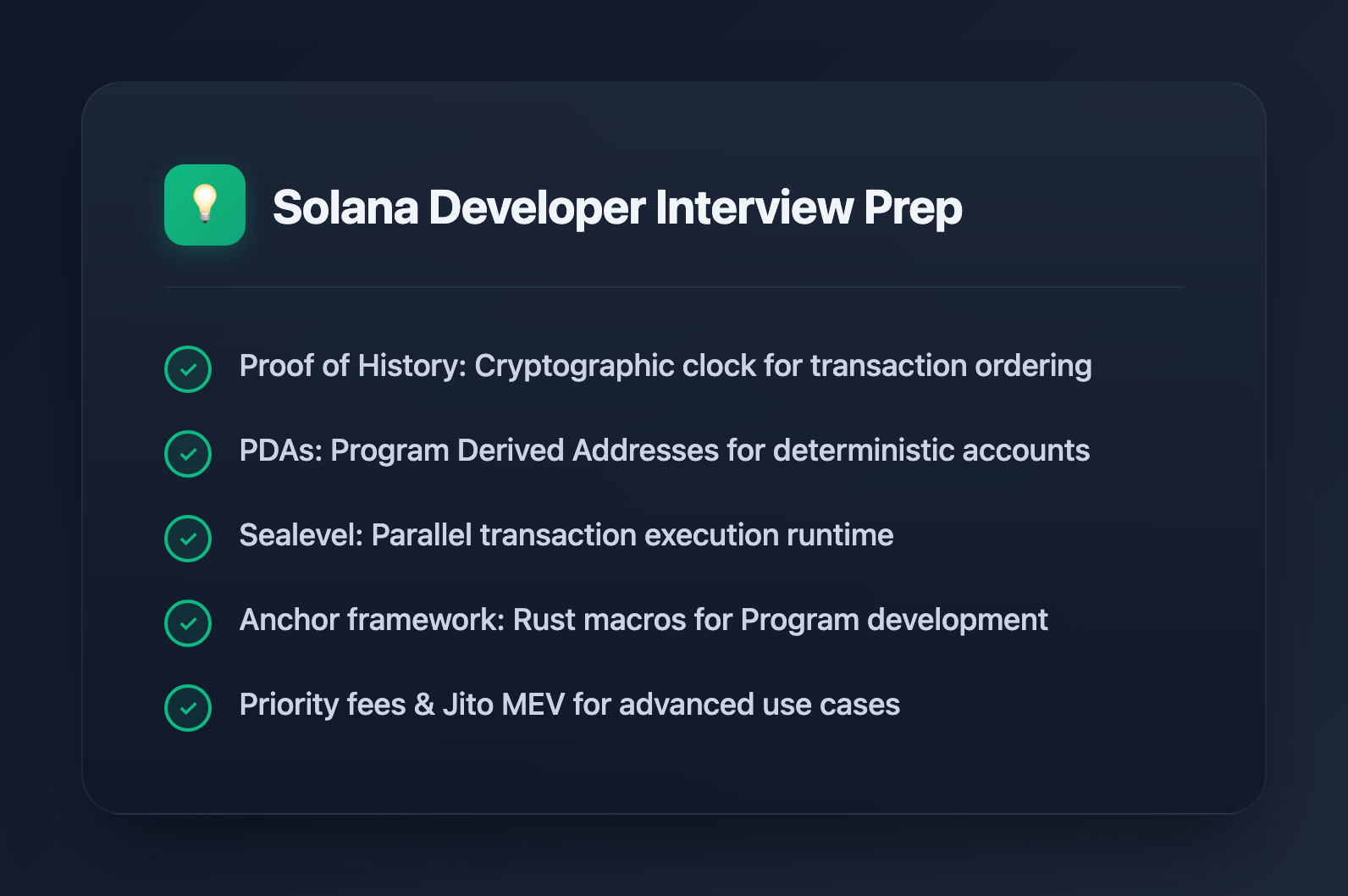
Solana developer roles are among the highest-paid in blockchain, with salaries ranging from $115,000 to $200,000+. This guide covers the most common interview questions you will encounter.
Solana Fundamentals
1. What is Solana and how does it differ from Ethereum?
Answer: Solana is a high-performance Layer 1 blockchain designed for speed and scalability. Key differences:
- Consensus: Solana uses Proof of History (PoH) + Proof of Stake vs Ethereum's Proof of Stake
- Speed: ~400ms block times vs ~12 seconds
- Throughput: 65,000+ TPS theoretical vs ~30 TPS
- Fees: Fractions of a cent vs variable (often dollars)
- Smart contracts: Called "Programs", written in Rust vs Solidity
2. Explain Proof of History (PoH)
Answer: Proof of History is a cryptographic clock that creates a historical record proving that events occurred at specific moments in time. It works by:
- Running a SHA-256 hash function continuously
- Each hash includes the previous hash as input
- The output serves as a verifiable timestamp
- Validators can verify the sequence without communication
This allows Solana to order transactions without waiting for network-wide consensus on timing.
3. What is the difference between a Program and an Account?
Answer:
- Programs are executable code deployed to the blockchain (like smart contracts). They are stateless and cannot store data themselves.
- Accounts are data containers that store state and SOL. Programs read and write to accounts they have authority over.
This separation enables parallel transaction processing - different transactions can execute simultaneously if they touch different accounts.
4. What is a PDA (Program Derived Address)?
Answer: A PDA is a public key derived deterministically from a program ID and seeds. Key characteristics:
const [pda, bump] = PublicKey.findProgramAddressSync(
  [Buffer.from("seed"), userPubkey.toBuffer()],
  programId
);- No corresponding private key exists
- Only the program can sign for it
- Used for program-owned accounts
- Deterministic - same seeds always produce same address
5. How do transactions work in Solana?
Answer: A Solana transaction contains:
- Instructions: Operations to execute (can have multiple)
- Signatures: From all required signers
- Recent blockhash: For deduplication (expires ~2 minutes)
- Fee payer: Account paying transaction fees
const transaction = new Transaction()
  .add(instruction1)
  .add(instruction2);
transaction.recentBlockhash = blockhash;
transaction.feePayer = payer;
@solana/web3.js Questions
6. What is @solana/web3.js?
Answer: The official JavaScript/TypeScript SDK for interacting with Solana. Version 2.0 (released Nov 2024) introduced:
- Tree-shaking support
- Zero dependencies
- 10x faster cryptographic operations
- Modern JavaScript patterns (functional API)
7. How do you connect to a Solana cluster?
Answer:
// Legacy v1
import { Connection } from "@solana/web3.js";
const connection = new Connection("https://api.mainnet-beta.solana.com");

// v2
import { createSolanaRpc } from "@solana/web3.js";
const rpc = createSolanaRpc("https://api.mainnet-beta.solana.com");
8. How do you create and sign a transaction?
Answer:
import { Transaction, SystemProgram, Keypair } from "@solana/web3.js";

const transaction = new Transaction().add(
  SystemProgram.transfer({
    fromPubkey: sender.publicKey,
    toPubkey: recipient,
    lamports: 1000000000, // 1 SOL
  })
);

transaction.recentBlockhash = (await connection.getLatestBlockhash()).blockhash;
transaction.feePayer = sender.publicKey;
transaction.sign(sender);

const signature = await connection.sendRawTransaction(transaction.serialize());
9. What are lamports?
Answer: Lamports are the smallest unit of SOL (like wei to ETH or satoshis to BTC). 1 SOL = 1,000,000,000 lamports (10^9).
10. How do you handle transaction confirmation?
Answer:
const signature = await connection.sendTransaction(transaction);

// Wait for confirmation
await connection.confirmTransaction({
  signature,
  blockhash,
  lastValidBlockHeight,
}, "confirmed"); // or "finalized" for maximum certainty
Confirmation levels:
- processed: Seen by connected node
- confirmed: Voted on by supermajority
- finalized: 31+ blocks deep, irreversible
Program Development
11. What languages can you use to write Solana Programs?
Answer:
- Rust (most common, best performance)
- C/C++ (supported but rare)
- Python via Seahorse (compiles to Rust)
Anchor framework is the most popular choice for Rust development.
12. What is the Anchor framework?
Answer: Anchor is a framework for Solana Program development that provides:
- Declarative macros to reduce boilerplate
- Automatic account validation
- IDL generation for client interaction
- Testing utilities
#[program]
pub mod my_program {
    use super::*;

    pub fn initialize(ctx: Context<Initialize>) -> Result<()> {
        // Program logic
        Ok(())
    }
}
13. How does account validation work in Anchor?
Answer: Anchor uses derive macros to validate accounts:
#[derive(Accounts)]
pub struct Initialize<'info> {
    #[account(init, payer = user, space = 8 + 32)]
    pub my_account: Account<'info, MyData>,
    #[account(mut)]
    pub user: Signer<'info>,
    pub system_program: Program<'info, System>,
}
14. What is the Solana Program Library (SPL)?
Answer: SPL is a collection of on-chain programs for common functionality:
- Token Program: Fungible tokens (like ERC-20)
- Associated Token Account: Standard token account derivation
- Token-2022: Extended token features
- Name Service: On-chain naming
- Memo: Attach data to transactions
Architecture & Performance
15. Why is Solana so fast?
Answer: Multiple optimizations:
- Proof of History: Pre-orders transactions without consensus delay
- Tower BFT: PoH-optimized consensus
- Turbine: Block propagation protocol
- Gulf Stream: Mempool-less transaction forwarding
- Sealevel: Parallel smart contract runtime
- Pipelining: GPU-accelerated transaction processing
16. What is Sealevel?
Answer: Solana's parallel runtime that executes transactions simultaneously. Transactions are sorted by which accounts they access - those touching different accounts run in parallel.
17. How do validators work in Solana?
Answer: Validators:
- Run the Solana software
- Validate and vote on transactions
- Produce blocks when selected as leader
- Earn rewards from inflation and fees
- Require staked SOL (self or delegated)
Security & Best Practices
18. What are common Solana security vulnerabilities?
Answer:
- Missing signer checks: Not verifying transaction signers
- Missing owner checks: Not verifying account ownership
- Integer overflow: Arithmetic without checked operations
- PDA seed collisions: Non-unique seeds
- Reinitialization attacks: Allowing account re-initialization
19. How do you prevent reentrancy in Solana?
Answer: Solana's architecture largely prevents reentrancy by design - programs can't call themselves recursively. However, cross-program invocation (CPI) requires careful handling of account state.
20. What is Cross-Program Invocation (CPI)?
Answer: CPI allows programs to call other programs:
let cpi_accounts = Transfer {
    from: ctx.accounts.from.to_account_info(),
    to: ctx.accounts.to.to_account_info(),
    authority: ctx.accounts.authority.to_account_info(),
};
let cpi_program = ctx.accounts.token_program.to_account_info();
let cpi_ctx = CpiContext::new(cpi_program, cpi_accounts);
token::transfer(cpi_ctx, amount)?;
Advanced Topics
21. What are priority fees and how do they work?
Answer: Priority fees increase transaction priority during congestion:
const modifyComputeUnits = ComputeBudgetProgram.setComputeUnitLimit({
  units: 200000
});

const addPriorityFee = ComputeBudgetProgram.setComputeUnitPrice({
  microLamports: 1000
});

transaction.add(modifyComputeUnits, addPriorityFee);
22. What is Jito and MEV on Solana?
Answer: Jito is a Solana client that enables MEV (Maximal Extractable Value) through:
- Bundles: Atomic transaction packages
- Tips: Incentives for validators
- Block engine: MEV extraction infrastructure
23. How do you handle RPC rate limits?
Answer:
- Use dedicated RPC providers (Helius, QuickNode)
- Implement exponential backoff
- Cache responses where possible
- Use websockets for subscriptions vs polling
- Batch RPC calls when possible
24. What is account compression?
Answer: Account compression uses Merkle trees to store data off-chain while maintaining on-chain verification. Used for:
- Compressed NFTs (cNFTs)
- Large-scale airdrops
- Gaming assets
25. How do you debug Solana transactions?
Answer:
- Solana Explorer: View transaction details
- solana logs: CLI log streaming
- anchor test: Local testing
- msg!() macro: Program logging
- Simulation before sending:
connection.simulateTransaction()
Related Resources
Learn how to build with Solana in our Solana JavaScript Development Guide with practical code examples.
For trading applications, see our Solana Trading Bot Guide covering DeFi strategies.
Conclusion
Solana development requires understanding its unique architecture - Proof of History, the Account model, and parallel execution. Master these concepts along with @solana/web3.js, and you'll be well-prepared for technical interviews.